

Interoception Technologies
Can we work it? A practical guide to working with interoception for therapists and clinicians.


Interoception is our most neglected somatic sense. It is the 6th sense - our sense of internal bodily signals. Today, interoception is thought to play a central role in emotion, cognition, decision making, mental states and in mental health.
But if interoception has a key role in emotion and mental states more generally, what can we do to intervene on these bodily signals? This piece is a deep dive into how and whether we should work it.
In this post I will:
Recap on definitions and interoception’s principal sensory channels and receptors
Describe three different interoception components
Look into whether more interoception is always better
Give you a list of interventions for modulating interoception
Share a selected state-of-the-art references
I wrote this with clinicians in mind, but it could be useful for almost anyone interested in the inner workings of the mind. I talk C-tactile afferents, interoceptive illusions, interoceptive exposure, relationship between trauma presentations and interoception and more.
My Interoception piece is not a required but is recommended: I delve into the definitions, basic notions, neural underpinnings and the role interoception is thought to play in allostasis and emotion.
Interoception

What is interoception and how it is linked to emotion, mental states and mental health.

Interoception of What?
OK, so interoception is sensing of the internal bodily states. Hunger, fatigue, tension, discomfort, arousal etc.
But is it one sense, or it is senses? Interoception, indeed comes through several different channels:
respiratory
cardiovascular
gastrointestinal
genitourinary
endocrine
The receptor cells involved in the process of interoception include:
mechanoreceptors
chemoreceptors
thermoreceptors
osmoreceptors
In fact, there is evidence that accuracy of interoception on one of these channels does not entrain interoceptive accuracy on other channels.
Interoception Dimensions
The research shows that the interoception can be broken down into three components or dimensions:
interoceptive accuracy
sensibility
awareness (metacognition)
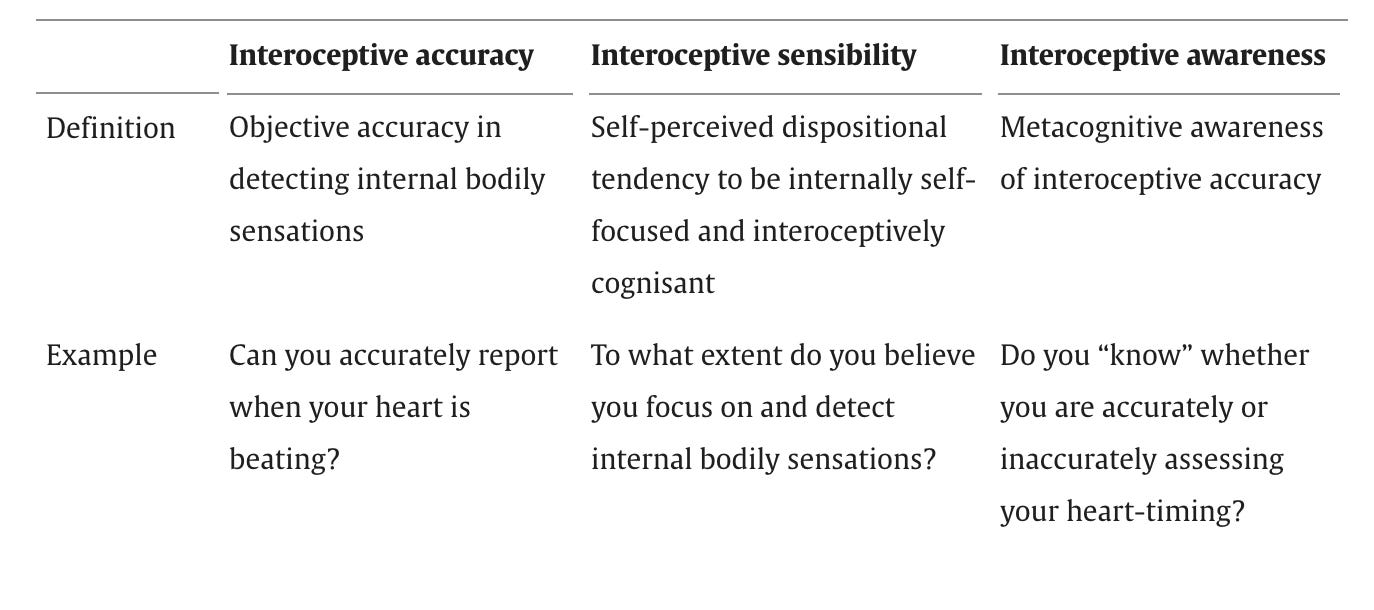
Furthermore, interoception senses are different between different systems- it does not mean that if you sense your breathing well you sense your heartbeat well.
Is More Interoception Always Better?
In therapy - especially when it comes to accessing therapy interventions that don’t fall within the CBT or psychodynamic canon - we are typically encouraged to support the client in tuning into their bodily sensations - in other words, we ask them to turn up their sense of interoception.
But is this something that is universally and indiscriminately beneficial? Or could it be that some clients are tuned in just fine as it is or even tuned in too much as it were.
Are there some therapy presentations where interoception is accentuated and needs to be turned down in some ways, learned to be ignored or even reframed all together?
Let’s have a look.
In Neuroscience & Psychotherapy I publish weekly dispatches from the frontier of neuroscience and psychotherapy, conversations with N&P friends and more, with plenty of practical material to help you work in a neuroscience-informed way.
If you like this piece please hit the ❤️.