

Maslow Was, In Fact, Wrong
What social neuroscience tells us about the hierarchy of human needs and the social brain.

Why humans have such big brains? Is it because we are so intelligent and clever? We certainly have bigger brains than any other of the large mammals. A large brain requires a large skull, and a large skull means a large head, including for the baby while it is still in mother’s belly. This big baby-head is, together with us being bipeds, the main reason why childbirth was and still is so hard, dangerous and frequently deadly (historically).
I have another question for you. Why do human babies and toddlers take so astonishingly long to become independent? Other animals, and this includes other hominids and primates, become functional and independent much more quickly. For humans, how long does it take before a child could survive on their own? Several years. To become fully functional, more like a decade and a half, I reckon? The period of immaturity is extremely protracted in humans.
That is an extraordinarily long time, and that brain is extraordinarily large. Both features appear to be major evolutionary liabilities. So what are they for?
To make my logic more explicit: if something carries such a substantial evolutionary cost, there must be an equally substantial evolutionary benefit. So what is that upside?
Is it simply our intelligence? We certainly like to think we are exceptionally clever. We’re not. Intelligence alone would struggle to account for how we came to occupy our rather peculiar position as perhaps the least physically intimidating apex predator the planet Earth has ever seen.
But before I tell you how all of this ties in together and why it has everything to do with the ‘social brain’, let me first tell you about Abraham Maslow (before I tell you why he was wrong).
This post is proper longform, and so feel free to skip to sections that are relevant for you:
What Did Maslow Get Wrong?
The Hell (And Heaven) Is Others: What Did Our Brain Evolve For?
Is It Only the Size That Matters: What Makes the Human Brain Unique?
Building A Social Brain
So, How We Fix It? (the new pyramid of needs)
What Did Maslow Get Wrong?
Once upon a time, there was a man called Abraham Maslow. He lived during the first half of the last century and was interested in human potential. He was one of the leading figures in humanistic psychology and the self-improvement movement.
Maslow, who worked closely with the Esalen Institute, reflected on the conditions needed for a person to reach their full potential. In the framework he devised, this ultimate fulfilment was called self-actualisation. According to Maslow, it was the highest stage of human development, a kind of secular, New Age enlightenment, if you will (I think).
As he thought about this question carefully, he came to the conclusion that one can arrive to fulfillment of one set of needs only if a set of more basic needs was already satisfied. We couldn’t just become moral beings that pursue creative endeavours and lack prejudice unless we have mastered the self-esteem, respect of and by others but also, beneath that, the level that pertains to more ‘basic’ needs such as the food, sex, sleep, having a roof over our head and other physical needs.
Maslow immortalised his insight in his 1943 paper A Theory of Human Motivation, introducing what would become the now iconic hierarchy of needs. The rest is history. In it, he says:
“At once other (and 'higher') needs emerge and these, rather than physiological hungers, dominate the organism. And when these in turn are satisfied, again new (and still 'higher') needs emerge and so on. This is what we mean by saying that the basic human needs are organized into a hierarchy of relative prepotency.”
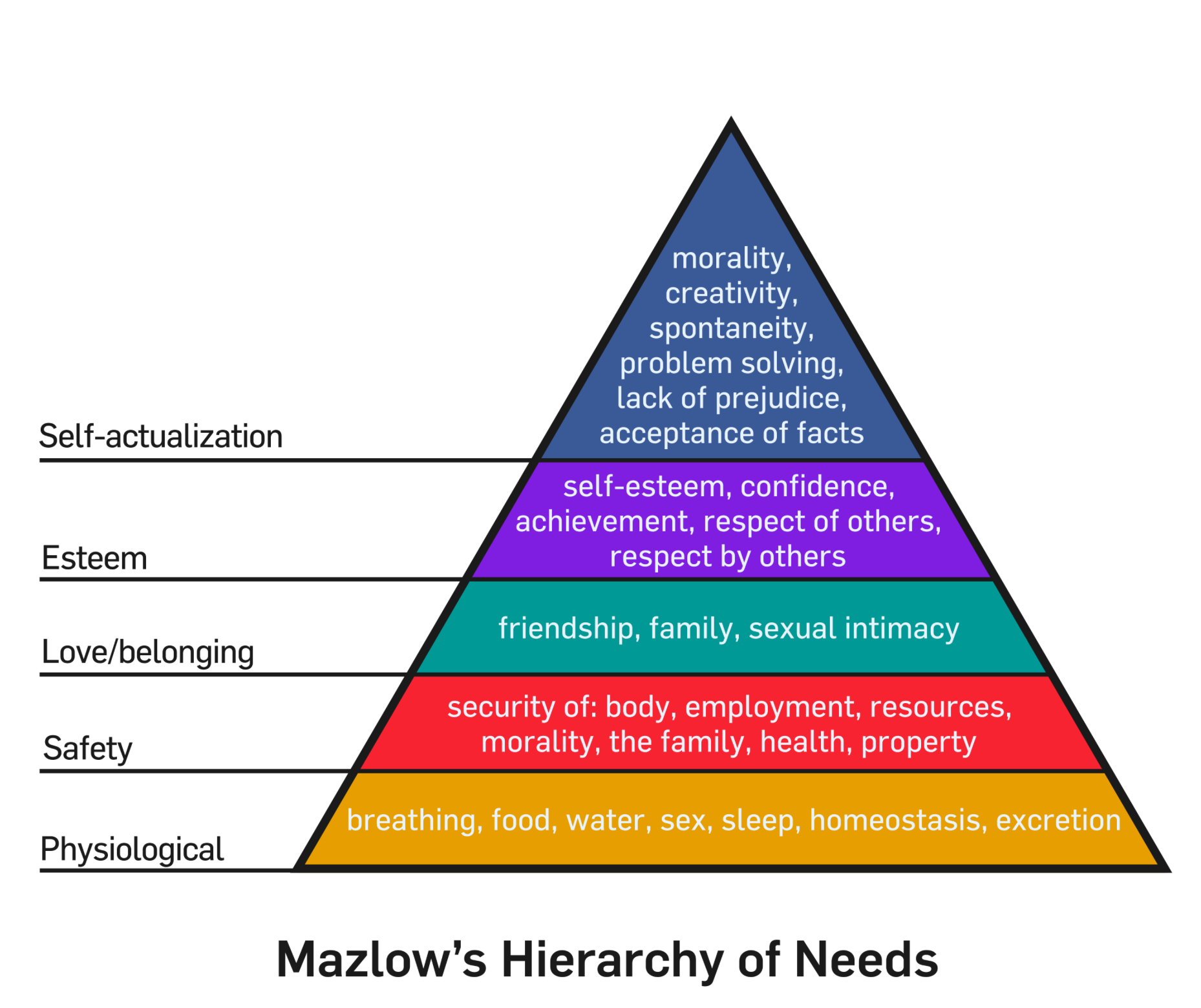
The Maslow pyramid, based on his hierarchy of needs, while certainly not regarded as holy scripture, has been highly influential in humanistic psychotherapy, including the person-centred approach, Gestalt therapy, Human Givens and Transactional Analysis. It is something of a landmark framework, one that I have heard therapists return to time and again when conceptualising and formulating their work with clients.
The criticism itself is not mine. I read it in the book Social: Why Our Brains Are Wired to Connect, by a social neuroscientist Matthew Lieberman, and it was a real penny drop moment for me. I recommend this book to everyone and reuse the argument that he made in the book here.
You see, if you look at the pyramid above you will notice that the first - minor - reference to social connections appears at the second layer of the hierarchy - under safety - as in safety, including safety of a family. However, the first layer that is actually properly social is the thirst layer - love and belonging.
And yet. Human babies, quite literally cannot exist without people caring for them. And that, quite literally, lasts for the first years of life. If I was to ask, for a baby, what is more important oxygen, food, water or human contact there can be no hierarchy there. They are all absolutely critical to survival.
In fact some modern frameworks - such as the Social Baseline Theory - consider the social connection to be equivalent to other homeostatic needs.
You see Maslow’s blind spot is one that I feel many of us still hold. We regularly, conspicuously underestimate the importance of our social bonds when thinking about life.
I am not suggesting that we underestimate their importance in the way we actually live. Rather, it seems to me that when we begin thinking about life and the forces that shape it, we tend to systematically underestimate how fundamental the role of social connection is for survival. (And, by extension, for our mental health and wellbeing)
I’ll give you an example from my work: people who find it difficult to be alone or without social support often blame themselves for being weak or needy, rather than recognising that they are missing something that is indispensable for life and survival.
Sociality is not a nice addition on the top of the basic needs. It is a basic need in itself. I hope that, by the end of this essay, I can convince you of that.
The Hell (And Heaven) Is Others: What Did Our Brain Evolve For?
The relationship with others is one of the most difficult things we have to mitigate in our lives. And also, if we are lucky, some of the most beautiful.
A mid-century French philosopher said that “the hell is others” and he was not wrong. Hell, heaven, sanctuary, safe and unsafe haven, and everything in between.
James Coan, a man who knows a thing or two about human relationships, has said it less poetically than the French intellectual, but his word come to the same effect:
“The first is that other people are absolutely necessary for long, healthy and happy lives.
The second is that other people are a pain in the ass.”
We should never forget that it is never simple. As we shall see, it may be that the brain is so large not simply to accommodate all the loving and caring, but also all the scheming, politicking and strategic manoeuvring in which we relentlessly engage, all while trying to convince everybody that we are not.
Sociality is not only about love, attachment and social support. It is also a game of mutual deception (jeu de dupes). We are masters of playing psychological and social games. We are fickle double-dealers. Think social signalling, think humble-bragging, think subtle manipulation, think reverse-psychology, think passive aggression. Now think about the sheer amount of computation the brain must perform to sustain the intense level of social cognition required to play these complicated social games. The scale of it is staggering. Never mind solving that maths problem.
All in all, it’s really complicated.
Yet, as the name we have given our species, Homo sapiens, suggests, we like to think that what truly distinguishes us from other animals is our wisdom or knowledge. Others also, I think, have called us, the Homo Habilis, the species that uses tools.
I don’t agree with any of that. If I think what matters really for people, I think of what people talk about in therapy. People rarely come saying that they struggle because they cannot solve a specific material or abstract problem, that they cannot learn how to use this or that machine or tool. What they do come to talk about is others. A lot.
I will borrow David Pinsof’s words again:
People like to think that humans are the smart ones in the animal kingdom. We alone evolved to learn stuff, figure things out, and use tools. But that’s only a small part of the story of human brain evolution. The bigger part of the story is social. Our brains weren’t designed for solitary contemplation; they were designed for arguing, rationalizing, politicking, rule-following, covert rule-breaking, and excuse-making. We are homo hypocritus.
It’s actually pretty obvious when you think about it. How much of your brainpower is devoted to office politics and social life, as compared to, say, auto parts? How much of your conversations are devoted to gossip and people-stuff, as compared to, say, home repair? If we naturally use 90% of our brainpower for dealing with people, it’s hard to argue that our brains evolved primarily for tools.
Can’t really argue with that, can I?
Is It Only the Size That Matters: What Makes the Human Brain Unique?
How does this stack up with what research in neuroscience and evolution of brain tell us? What makes the human brain unique?
It somewhat a leading question, implicitly suggesting that there would be only one thing that the human brain evolved for. And of course, that is not true. The human brain has evolved for problem-solving AND for using tools.
But, I bet what comes to mind is the prefrontal cortex, the prized human evolutionary expansion, am I right?
And to be sure, I think that the previous research on how special and unique human brain is has focused on things such as the relative size of the prefrontal cortex (human cortex is 1.2 times bigger that in chimpanzee and 1.9 bigger than in macaques).
Recently, however, researchers have asked this question differently: in what ways is the internal brain organisation unique in humans, compared to its close relatives?
They then compared the connectivity patterns between human brain and its primate relatives. In this context, the connectivity refers not to the functional connectivity but the physical connectivity of the the white matter within the cortex - in essence the myelinated axons that act as ‘communication cables’. Courtesy of new technology, it is today possible to have ‘white matter atlases’. This allows to identify and compare different connectivity fingerprints, for each species. This, in turn, effectively allows for quantitative comparison of brain organization, across species.
There was surprise in the results. The main differences were not observed in the prefrontal cortex, as expected. Instead, they were located in the temporal lobe (part located behind the temples).
These areas are involved in integration sensory and motor information to facilitate higher-order cognitive functions like perception, language and abstract thought, these findings challenge the idea that human intelligence comes from one single origin (and it might not be only one type of intelligence).
One particular area stood out, however, when it comes to human sociality: temporoparietal junction, showing much more extensive connections to other brain regions than in other primates.
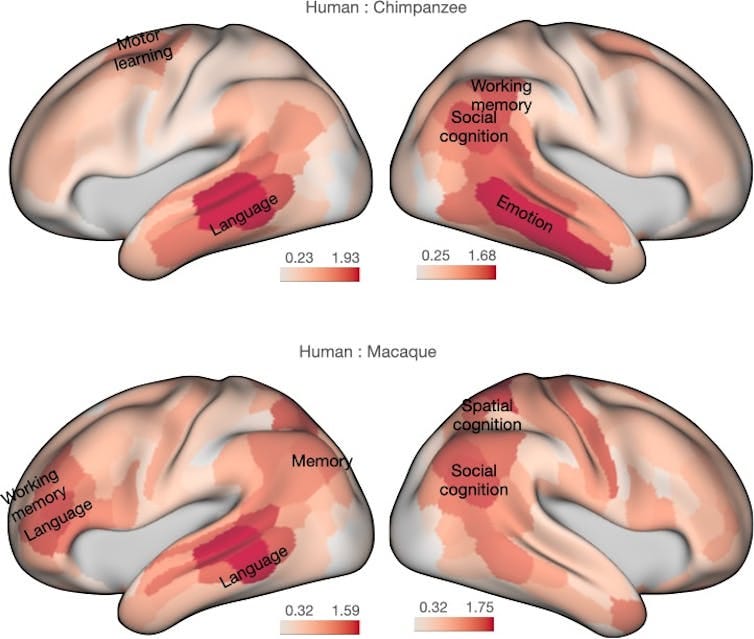
Now, temporoparietal junction is one of the main players neurally underpinning the theory of mind. It is a key node of the mentalization network. Its high connectivity suggests that it might be one of the neural substrates allowing for handling and processing of complex social situations.
Mentalization is the capacity to ‘theorize’ and elaborate on possible reasons of other people’s behaviours in relations to one’s own, including their states of mind, different of one’s own.
Mentalization is an aspect of social cognition and no wonder that kind of cognition requires a complex machinery to implement it, as the combinations, the reasons and motivations for why someone else than us does something or thinks something are virtually endless.
Going back to the original question at the beginning of this piece: how did we, a species that is physically so unassuming and meek, come to be the Earth’s apex predator? Well, not through intelligence alone. We achieved it through social intelligence and cooperation. And that makes perfect sense. It is only through cooperation and group organisation that every great feat of human civilisation has ultimately been accomplished, whether it is something you admire or something you condemn.
And to achieve things together, we need not only to cooperate, but also to scheme, build alliances, engage in politics, manipulate and, at times, coerce. We need to be very, very good at social cognition, in all its forms, the good, the bad and the ugly.
In Neuroscience & Psychotherapy I publish weekly dispatches from the frontier of neuroscience and psychotherapy, conversations with N&P friends and more, with plenty of practical material to help you work in a neuroscience-informed way.
If you like this piece please hit the ❤️.
Building A Social Brain
In truth, the expression “the social brain” is a bit misleading because I think it cannot be said that one specific localised area of the brain is in charge of human sociality. As many other complex things, it ultimately is a whole brain affair.
Still, some interesting things can be said.
I’ll start with the amygdala. Yes, that little bad boy. You didn’t expect it? Amygdala is very important for sociality - individuals with an impaired amygdala experience great social difficulties. You can read more about it in my piece Redeeming the Amygdala.
The Default Mode Network (DMN). I have heard many criticism of the very definition of this intrinsic brain network, and I am waiting for someone to write a comprehensive piece on the problems with it being “what brain does when it does nothing” (anyone?). BUT. It turns out that the DMN could have been called the Others Mode Network and in fact it overlaps in many regions with the mentalization network I spoke about in the previous section. It turns out, when we do nothing we still think about others (see here and here). I mean, this fundamentally begs the question is there even such thing as us without others?
Other processes and their neural underpinnings have been included in the ‘social brain’, other than theory of mind (aka mentalization). Those include threat detection, self-regulation, empathy, morality, trust and trustworthiness, social rejection and much more.
Social brain is also attachment brain, which again is a whole brain affair. Attachment is not in the right hemisphere, it is not governed by the state of the vagus nerve or located in the brainstem. Attachment is everywhere in the brain.
So, How We Fix It? (The New Pyramid)
So, if it’s not Maslow’s pyramid, what is it?
There. I fixed it for you. (I call it the bio-psycho-social pyramid of needs)
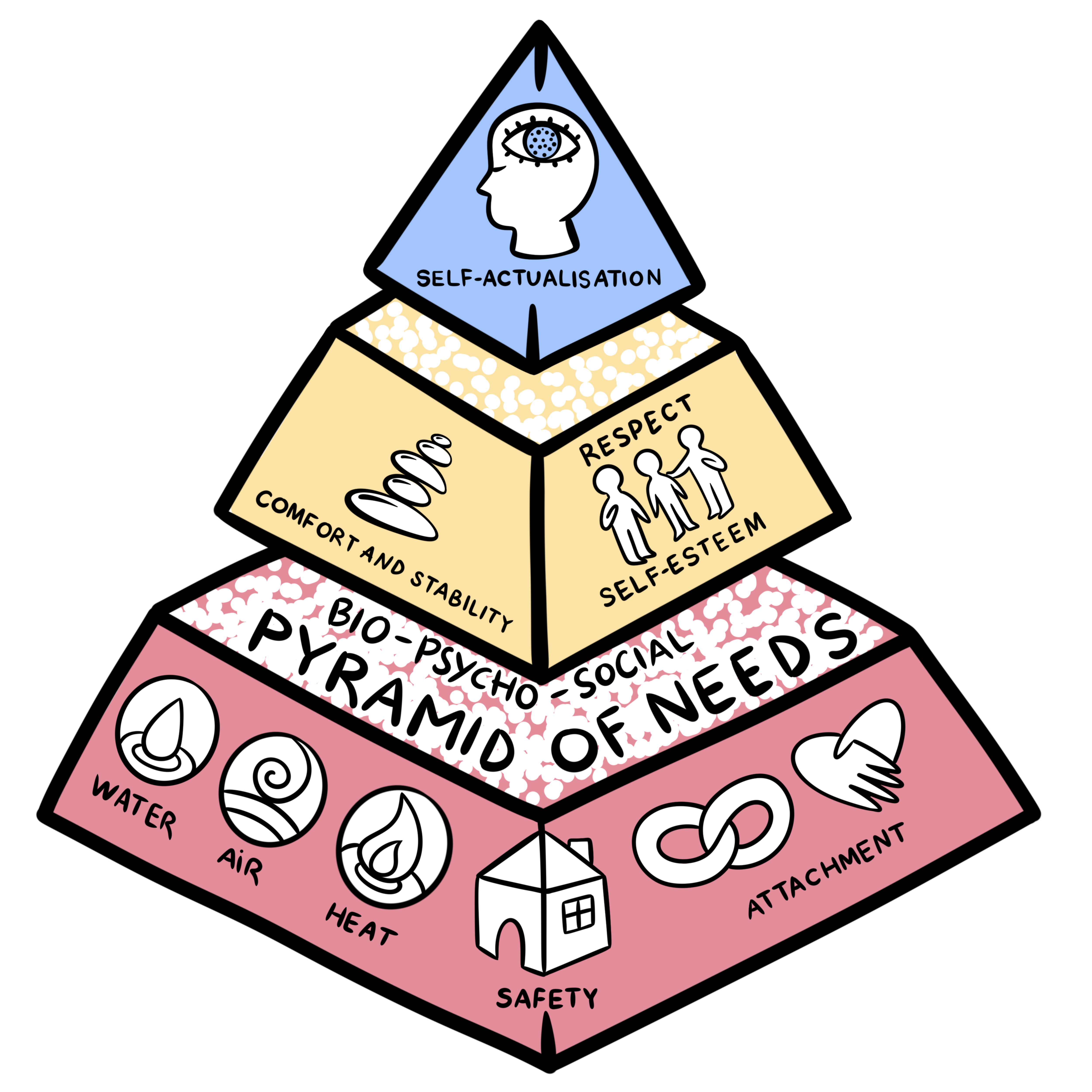
So where do you stand in this? Do you think we underestimate the importance of our social connections in our society?
Is there anything that would change in your life once you understand, but really understand, that the presence of social connection, and preferably meaningful one in that, is in fact not only one of the nice things that life gives us but necessary for the sustenance of life itself, just like oxygen, water, food or sleep?
When I think about people around me, or people I work with, I see too many still not fully realising that the social connection, in all its different forms, is our sine qua non. Our natural state.
Any thoughts, let me know. As always, thank you for reading 🙏.
In Neuroscience & Psychotherapy I publish weekly dispatches from the frontier of neuroscience and psychotherapy, conversations with N&P friends and more, with plenty of practical material to help you work in a neuroscience-informed way.
If you like this piece please hit the ❤️ and consider subscribing.
References
History and Methods of Social Neuroscience, Matthew Lieberman, Social Cognitive Neuroscience
Pascal Vrticka et al, Charting the social neuroscience of human attachment (SoNeAt)
Atzil S, Gao W, Fradkin I, Barrett LF. Growing a social brain. Nat Hum Behav. 2018
Connectivity Profile and Function of Uniquely Human Cortical Areas
Quantitative assessment of prefrontal cortex in humans relative to nonhuman primates

Redeeming The Amygdala.

Where we argue that the amygdala isn’t that bad boy that it is made out to be. If anything, it deserves a little redemption.
Maslow was inspired by a trip to the Blackfoot people in Canada… only to then fail to actually understand how their society works. Some very interesting stuff:
https://anzswjournal.nz/anzsw/article/view/959/822
And yet, mentalising is constrained to a subset of mental state possibilities, not the set of all mental states. That in and of itself, is interesting. Plus it’s really easy for a lot of us to do!
Equally, the idea that we theorize about what is going on in someone else’s mind is one idea about how we do it. The other side of that argument being that we simulate it. Although it’s not entirely improbable that different people have different ways they mentalise.