



This is a hands-on post about the mechanics of emotion regulation, and is mostly intended for clinicians or people whose work is to help other people regulate their emotions.
But before we dig in in the earnest, I just want to provide a bit of a historic perspective on the concept of emotion regulation.
You see, I was under impression that the term emotion regulation was around forever. It seems ancient. So ancient, in fact, that we needed a fresher incarnation which, I think, came in the form of its neuro-mystical, irreverent cousin, nervous system regulation, fitting for our times, in which neuro has become the new frontier of self-optimisation.
But I stand corrected. The term emotion regulation is not ancient at all. It turns out that the field of emotion regulation in clinical psychology emerged only in the ‘90s.
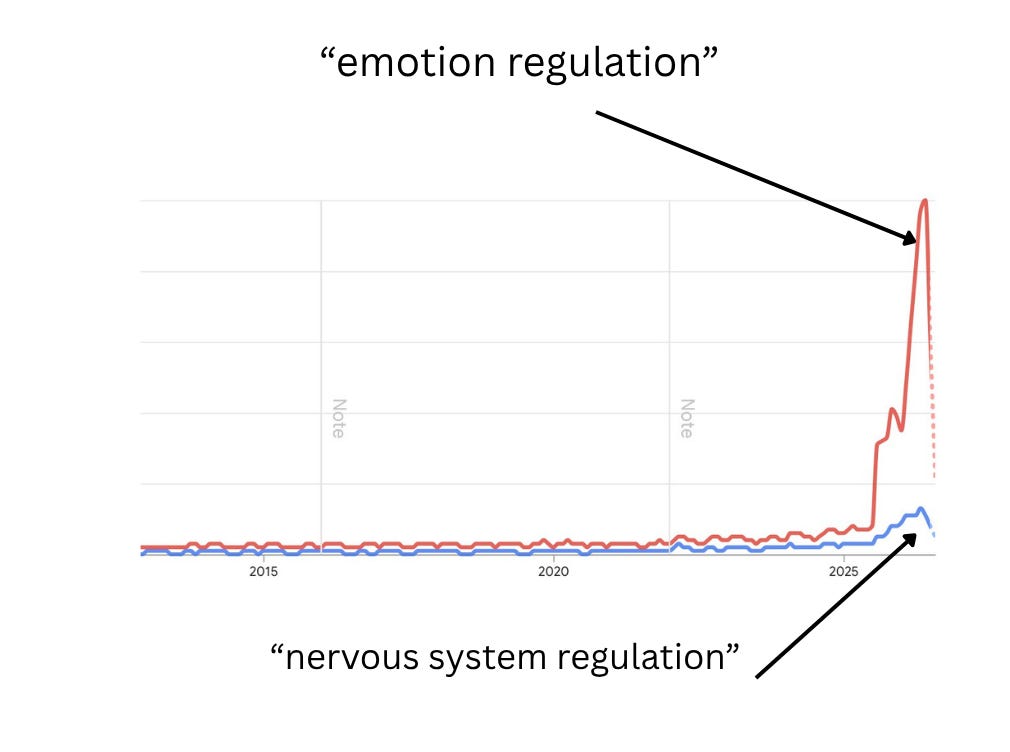
Furthermore, people still seem to use emotion regulation - as suggested by the graph below that represents the searches of terms “emotion regulation” vs “nervous system regulation”. You can see that the former is in the lead, and by a long shot.
From where we I stand today, and given how much airtime different kinds of regulation, emotion or otherwise, are given, it is difficult to imagine a conceptual space of therapy and mental health where those entities were absent, both from the public discourse and from our own heads.
The historic vignette out of our way, I want to focus on how psychology and neuroscience research has come to conceptualise emotion regulation, unpack its inner workings and how that knowledge can help us in therapy.
In this post I will:
define what emotion regulation is ( and delineate from related but distinct constructs )
describe a prominent model used in psychology and neuroscience to conceptualise emotion regulation
describe different access points that can be used to target emotion regulation
describe the main categories for emotion regulation and how they fit into different stages of how emotion unfolds
provide a comprehensive map for devising emotional regulation plan for your clients (or yourself, if you are so inclined)
Real Quick: What Is Emotion?
I think I heard Joseph LeDoux - affective neuroscientists who has conducted seminal research on the role of the amygdala in threat processing - saying the following:
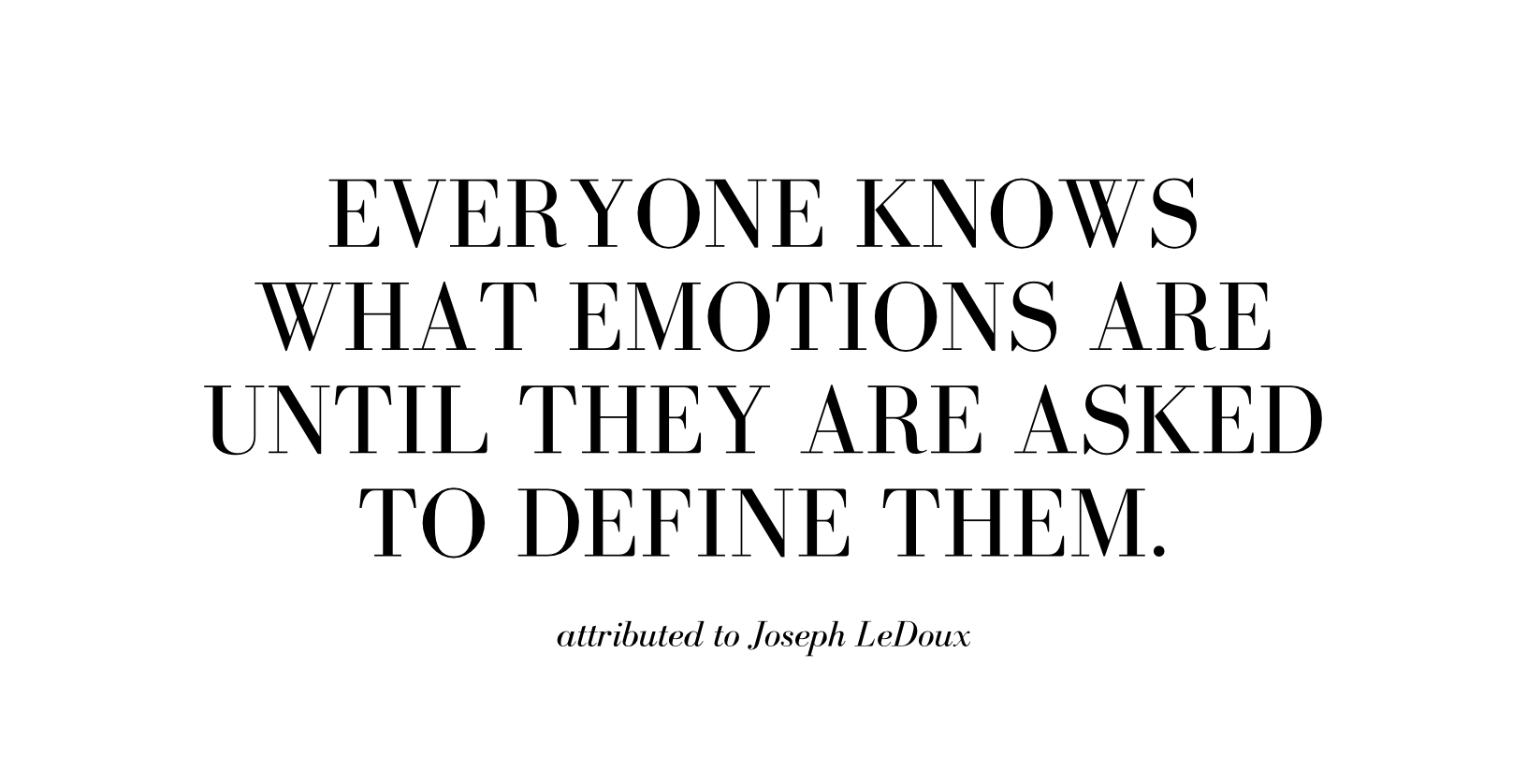
And so researchers, including neuroscientists, are still not really able to agree on what emotion is.
What everyone seems to agree on though is that the one of the constitutive parts of emotion is core affect - while feelings or emotions would be the cognitive elaboration of these signals.
Inherent to core affect is the evaluation of the state - is it pleasant or unpleasant, good for me or bad for me. Another aspect of affect is its intensity. These are not the only aspects of core affect but are the ones that are most commonly referenced - in the idea of emotion circumflex (see the picture below).
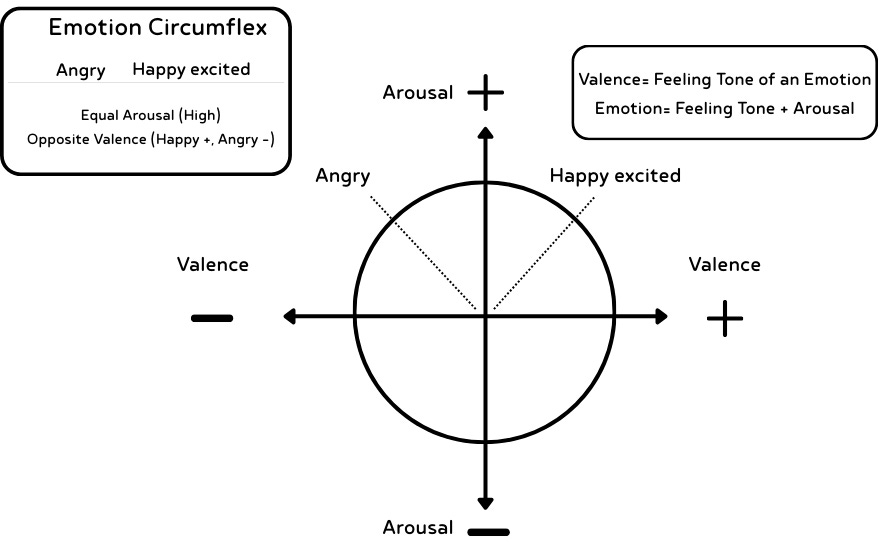
According to the framework I will use here, the category of affective states includes feelings or emotions (I don’t make a difference between the two), mood but also states of high felt stress.
More about emotions and different theories of what they are can be found in Where The Wild Things Are: In Search of Neuroscience of Emotions.
Ultimately, two things can cause emotion: external events and circumstances and - a very human capacity - to have thought process that propulse us into the future or the past and ‘simulate’, as it were, the specific events and circumstances. This ‘simulation’ does not involve only the mental representations but also elicits the bodily states change, including the stress and the ANS response.